Chapter 3 · Context · 8 min read
On this page7
Teach Claude your project
Claude doesn't remember. Every conversation starts cold. A good CLAUDE.md gives it the shortcuts it would otherwise have to rediscover — which makes every prompt land better.
Why context matters more than the model
Model quality is commoditized. The differentiator is what you feed it. A weaker model with great context usually beats a stronger one with none.
Three failure modes you'll recognize:
- "It gave me code that ignores our conventions" → you didn't tell it the conventions
- "It suggested a library we don't use" → you didn't list the ones you do
- "It kept asking questions I already answered" → you didn't write it down
CLAUDE.md is where you write it down once. Except — you don't write it. Claude does.
Let Claude draft it
Inside your project, run:
/init
Claude scans the repo and proposes a CLAUDE.md with what it found — stack, structure, common scripts, obvious conventions. For the newer interactive flow that also proposes skills and hooks, set CLAUDE_CODE_NEW_INIT=1 before running.
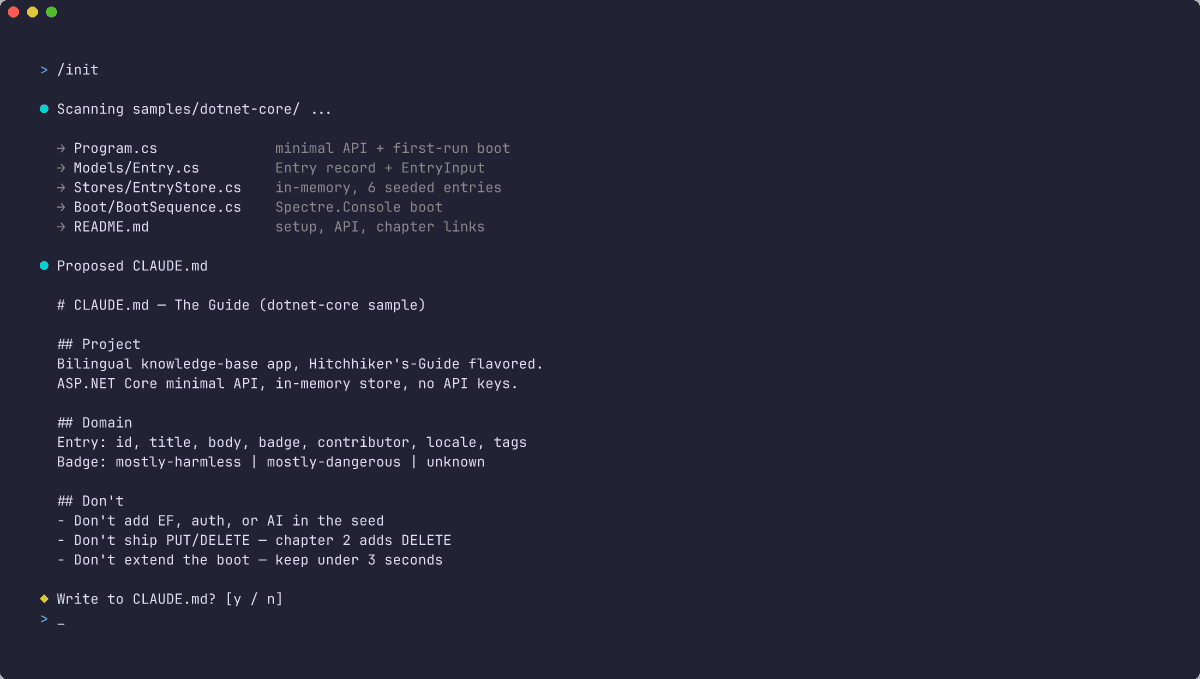
The output is a starting point, not a finished doc. Now ask Claude to refine it:
Re-read CLAUDE.md and add the three conventions we've been using this session — strict TypeScript with no any, tests next to the file they cover, database migrations as numbered SQL files. Keep each section short.
Then:
Re-read CLAUDE.md and add a Don't section with the rules we keep rediscovering — don't touch app/legacy/, don't install new packages without asking, don't run migrations automatically.
Claude will edit the file and show you the diff. Review, accept, commit. The document grew by you asking for rules you know, not by you typing rules into a file.
What ends up in it
If you're curious, here's the shape Claude usually produces. Don't type this — let Claude write it from your answers.
# CLAUDE.md

## Project
Internal tool for customer onboarding. 3k DAU, Postgres + Node, deployed on Vercel.

## Conventions
- TypeScript strict mode. No `any` unless commented.
- Tests live next to the file: `foo.ts` + `foo.test.ts`.
- Database migrations are numbered SQL files in `/db/migrations/`.

## Don't
- Don't install new npm packages without asking.
- Don't touch `app/legacy/` — that's frozen pending rewrite.
- Don't run migrations automatically.

## Useful commands
- `pnpm dev` — local server on :3000
- `pnpm test` — vitest, watch mode
- `pnpm db:seed` — reset local DB to fixture state
Target under 200 lines per file. Longer files consume more context and reduce adherence. Chapter 9.4 has the deeper best-practices reference.
Update it as you learn
When Claude does something you correct, you don't have to stop and edit CLAUDE.md. Just start your next message with #:
#migrations must be reversible — write the down migration alongside the up one
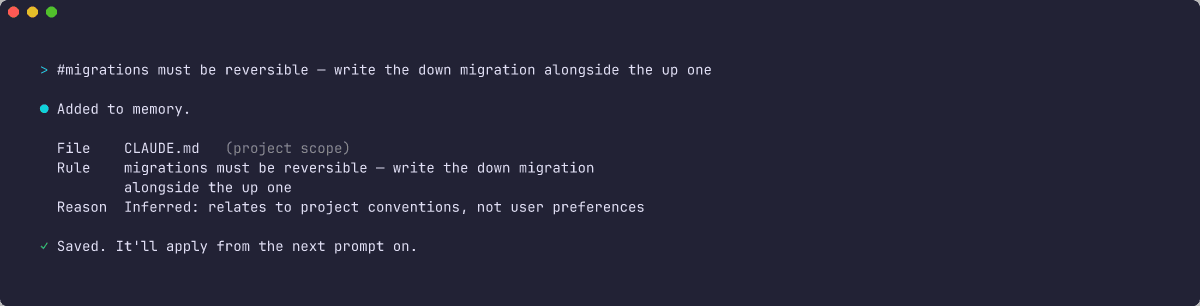
That's the memory-add prefix. Claude takes the line after #, decides which scope (project / user / local) it fits best, and appends it to the right CLAUDE.md. You stayed in flow, the rule got captured.
Scope: managed, user, project, local
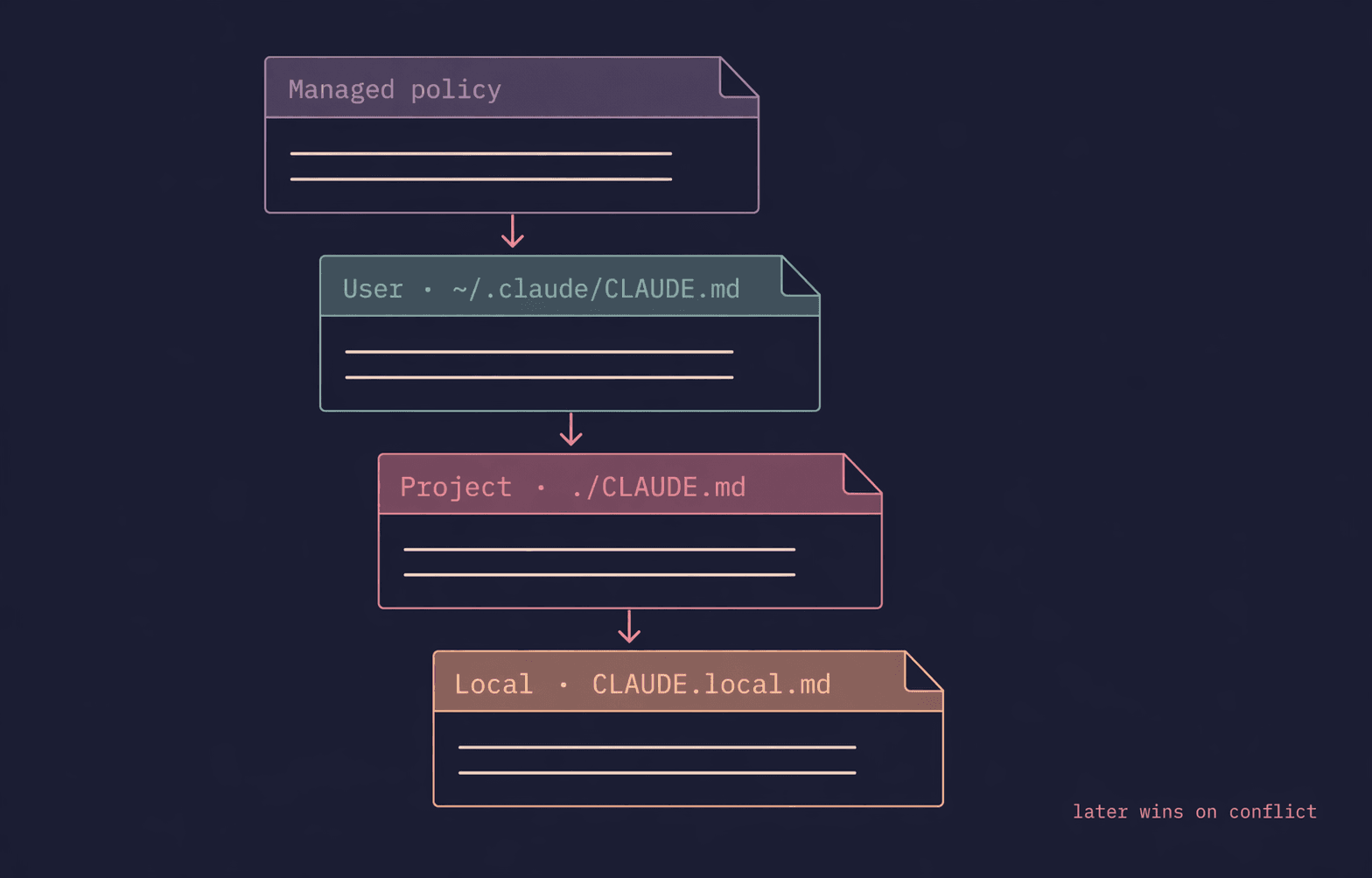
Up to four layers load at session start. Later in the chain wins when rules conflict:
- Managed policy — enterprise-deployed via MDM. Can't be overridden locally. Only present on managed fleets.
- User —
~/.claude/CLAUDE.md— about you: editor preferences, shell habits, tone. Loads for every project. - Project —
./CLAUDE.mdor./.claude/CLAUDE.md— about this codebase: conventions, commands, don'ts. Committed, shared with the team. - Local —
./CLAUDE.local.md— about you in this project: local paths, secrets, WIP notes. Gitignored.
Nested CLAUDE.md files in subdirectories load lazily — only when Claude reads a file inside that subdir. Useful for monorepos. Alternative: .claude/rules/*.md with paths: frontmatter, which only activates when matching files are touched.
→ Anthropic memory docs ↗ — the canonical reference.
Keep it a map, not a manual
Context is scarce. A CLAUDE.md that tries to say everything crowds out the thing it was supposed to help with — the task, the code, the relevant docs.
OpenAI's Ryan Lopopolo ↗, writing about shipping a production system mostly from Codex, calls this out directly: keep your AGENTS.md / CLAUDE.md around 100 lines, and treat it as the table of contents. His framing: Claude should be "a map, not a 1,000-page instruction manual." The real knowledge lives elsewhere — structured docs the agent opens only when it needs them.
What that looks like as a section in your CLAUDE.md:
## Where to look
- Architecture decisions — `docs/adr/`
- On-call runbooks — `docs/runbooks/`
- Payment refund flow — `docs/runbooks/refunds.md`
- Style guide — `docs/style-guide.md`
- Deeper API reference — `docs/api.md`
Now Claude scans the map in every session without reading the encyclopedia. When the task mentions refunds, it opens the runbook. When the task is a new endpoint, it reads the style guide. You write each doc once, in its own file, at its own size — and the map stays short.
Practice: continue your sample
Working through the lab in order? Take what this chapter taught to the sample you started in chapter 2 — or to a codebase of your own, where it'll land harder.
- Open your project folder in Claude —
samples/dotnet-core(Stream A — the .NET Guide),samples/python-react(Stream B — the python-react Guide), or a repo of your own. Both samples ship with a starterCLAUDE.mdthat already teaches the Entry domain and the badge rules; your own repo may or may not. Either way, read what's there before touching anything. - Run
/init. Claude proposes an updatedCLAUDE.mdbased on what it sees. Compare the proposal with what you've got — what does it miss, what does it add that doesn't fit, what's genuinely better. Accept the parts that are, edit the rest. - Use the
#prefix to add one or two rules that came up in chapter 2, or that you've been repeating to teammates — "always return JSON errors with anerrorfield", "before adding an endpoint, add a matching test." Watch which scope each lands in; project scope is what you want for codebase-wide rules. - Add a Where to look section — one or two pointers to real destinations. If your repo has runbooks, an ADR folder, or a style guide, point at them. If not, point at where they'll live (
docs/runbooks/,docs/adr/). The pointer is the commitment.
When it works: your CLAUDE.md is yours — short, opinionated, and linking out to the docs you'll actually reach for. The next chapter's practice uses plan mode to add a second feature.