Library · 8 min
Goes deeper from Iteration and control
On this page8
Context engineering as practice
The context window is a budget. Every turn spends some. Every file Claude reads spends more. By the time the conversation feels long, half the budget is gone to material that already did its job.
Context engineering is the daily habit of treating that budget as something you actively manage — not something that fills up and one day runs out.
Most builders learn the commands (/compact, /clear, /resume) and then stop. The commands aren't the practice. The practice is knowing which one fits the situation, and noticing the situation early enough to choose.
The four moves
You have four ways to free context. Each one trades something different.
| Move | What it keeps | What it loses | When to reach for it |
|---|---|---|---|
/compact [focus] | The thread. Decisions you made. The agent's mental model. | Verbatim history. Scratch work. Tangents. | Mid-task, you need breathing room but don't want to re-explain the goal. |
/clear | Nothing in the active window. The old conversation is archived (resumable). | The whole conversation. Including the bits you'd rather keep. | Pivoted to a different area. Or the conversation has 30+ turns and is drifting. |
/resume | A specific past conversation, restored. | Whatever was running in the current one. | You realized the answer to today's question lives in yesterday's session. |
| Walk away. Start fresh. | A clean board. New CLAUDE.md. Sharper prompts. | Any state you didn't write down. | You're not sure what you want anymore, or the previous attempts have shaped your prompts in ways you don't trust. |
The cheap-but-overused move is /compact. The expensive-but-underused move is the fourth one. Walking away from a session that's gone sideways is almost always faster than rescuing it.
Three layers of memory
Conversation context is one layer. There are two more, and they cost less.
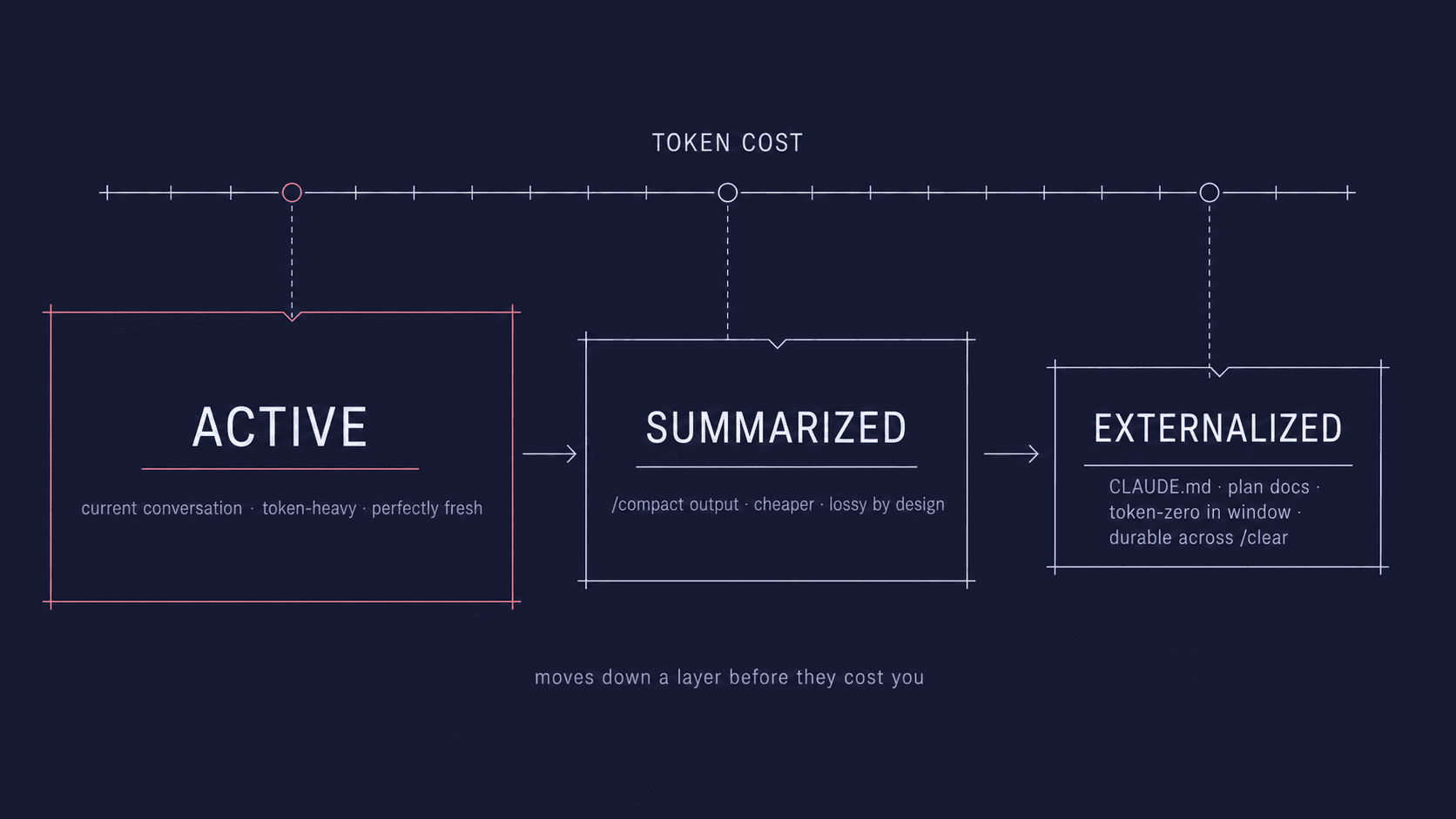
Active context is what's in the current conversation. Token-heavy, expensive to keep, perfectly fresh. Every turn lives here.
Summarized context is what /compact produces — a Claude-written précis of the turns so far. Cheaper than verbatim, lossy by design. Useful as long as the summary still describes the work accurately.
Externalized context lives outside the conversation entirely. CLAUDE.md, plan docs, brainstorm files, scratchpads. Token-zero in the active window — Claude reads them on demand. They don't decay when you /clear.
The skill is moving things down a layer before they cost you.
Summarize what we just figured out about the auth flow into docs/notes/auth-decisions.md, then we'll clear and start the implementation fresh.
That move turns 40 turns of conversation into a file Claude can read in one. The implementation conversation starts at zero context cost and full informational value. That's the whole game.
/compact recipes
/compact with no argument keeps a balanced summary. With a focus argument, it keeps what matters and forgets the rest.
/compact focus on the API design decisions; drop the debugging tangents
/compact focus on the failing test and what we tried; drop the file-reading turns
A good focus argument is specific about what to keep, not what to drop. "Keep X" gives Claude a target. "Drop Y" leaves the rest ambiguous.
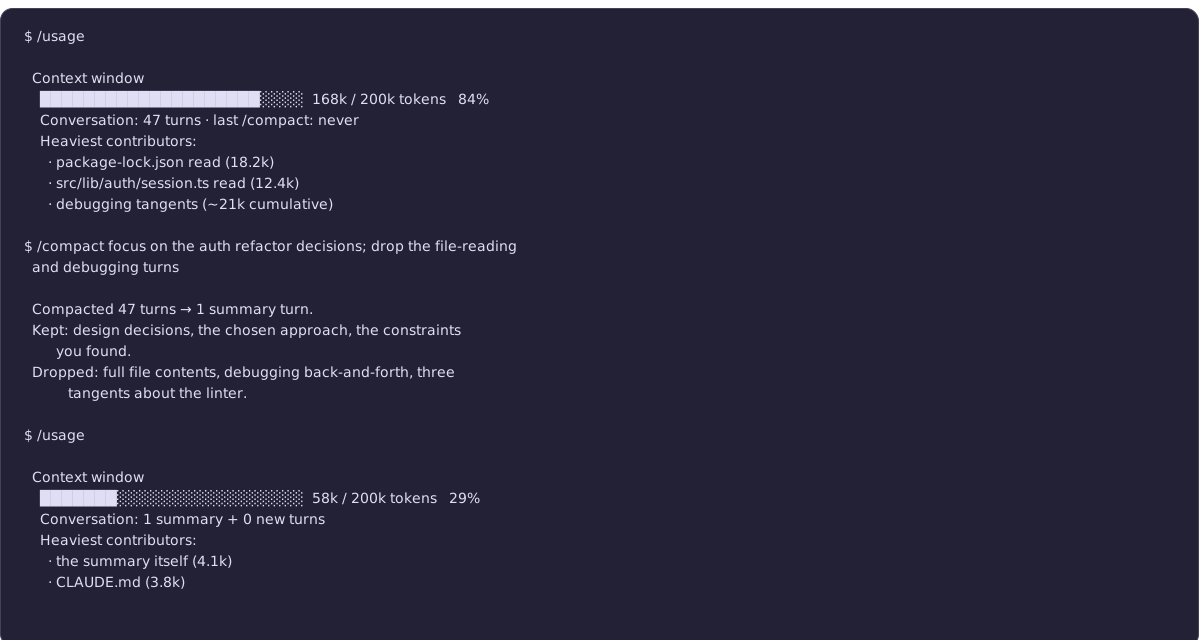
Pro move: before a handoff, run /compact focus on what's left to do and why this approach. The summary becomes a handoff note for free.
/clear recipes
/clear is the cheapest move and the one most builders avoid out of loss aversion. The previous conversation isn't gone — it's archived. /resume brings it back if you need it.
Three high-value moments to clear:
- Between phases of Compound Engineering. Brainstorm turns muddy a plan. Plan turns colour an implementation.
/clearbetween phases gives each one sharp context. - Between unrelated tasks. You finished the auth refactor. Now you're touching the search index. The auth conversation contributes nothing useful and a lot of noise.
- When the conversation has lost the plot. You've corrected Claude four times. The corrections themselves are now in context. Start over with a tighter prompt.
The tell that you should have cleared earlier: re-explaining something that Claude knew thirty turns ago.
/resume mechanics
Conversations don't disappear. /resume lists recent ones; pick one, you're back where you were.
This matters more than it sounds. Two patterns:
- The "I cleared too eagerly" recovery. Cleared, started fresh, hit a wall, realized the answer was already in the previous conversation. Shortest path:
/rewind— it now reaches back before a/clearand restores the conversation directly. Longer path:/resume, copy the relevant turn,/clearagain, paste it as context. - The "yesterday's session" recall. You explored an approach yesterday, hit a wall, slept on it. Today you have a new angle.
/resumethe old conversation rather than starting cold — yesterday's understanding is still loaded.
/resume is also how you split a long-running thread across days without losing the thread.
Externalize before you forget
The strongest context-engineering habit is the boring one: write things down outside the conversation.
- Decisions →
docs/decisions/<topic>.md. One line, one date, why. - Plans →
docs/plans/<feature>.md. The agent reads this every time it works on the feature. - Patterns →
CLAUDE.md. Repo-wide rules and shapes that should never be relearned. - Scratch → a
scratchpad.mdyou don't commit. Free-form thinking that the agent can read but doesn't pollute git history.
When you write to a file, you're moving context from the active layer (expensive, lossy on /clear) to the externalized layer (cheap, durable across sessions). The conversation gets shorter; the project gets smarter.
A 200-token line in CLAUDE.md replaces hundreds of tokens of repeated re-explanation across every future session. It pays for itself within a week.
Anti-patterns
Compact and pray. The conversation is bloated. You run /compact without a focus arg, hoping the summary is good. Sometimes it is. Often it loses the one detail that mattered. Compact with a target.
Clear and lose state. /clear without first writing down what you'd lose. The prompt that worked, the file path you discovered, the constraint Claude figured out — gone, not in /resume because you've already moved on. Two-second habit: before clearing, ask Claude to dump the state into a file.
Over-stuffed CLAUDE.md. Externalization is good; eternal externalization is bad. A CLAUDE.md that has grown to 800 lines is now a context cost on every session. Trim ruthlessly. Move project-specific patterns to feature-scoped docs that the agent reads only when it touches that surface.
Avoiding /clear out of sentimentality. The conversation that helped you is not the conversation that helps you next. Old turns are sunk cost. The archive is one command away.
How this connects to the spine
Chapter 4 — Iteration and control introduces /compact and /clear at the level a chapter can support. This entry goes further than the chapter could without ballooning the path.
Chapter 3 — Teach Claude your project is the externalization end of context engineering — CLAUDE.md, project docs, the durable layer. Read it alongside this entry.
Chapter 7 — Compound engineering is where the four moves and three layers come together as a workflow. This entry gives you the moves; that chapter gives you the choreography.